Welcome

Welcome, this site will be devoted to providing information about the ongoing maintenance issues that take place at The Creek Club . As this site is developed, content will be added that demonstrates things that range from course care to comprehensive details about agronomic procedures. I hope that this will become a useful tool in communicating things that are taking place on the golf course. I will try to use the blog to explain how and why we do some of the things we do on the golf course.


Monday, May 13, 2013

“Why are we aerifying green just when they are rolling perfectly?”


“Why are we aerifying green just when they are rolling perfectly?”  I hear this question every time we start the process!  I love to play golf so I can relate to member about playing on aerified greens however as a Superintendent its like have new greens after the process is completed!  As many as you know the art to having good Bentgrass greens is doing the agronomical sound things that help ensure that Bentgrass survive the summer months.   Aerification is one of those tools we use because it reduces organic matter (thatch), reduces soil compaction, Increases air exchange in the soil, water infiltration, and promotes deeper rooting.

On May 8th we started our Big Spring Aerification this is a major labor intensive process the following pictures below will better tell story about what we did this year.

  1st .  Process Verticut two directions 1/4 deep .
Thatch and  Severed creeping stolons
We were able to remove a good bit of thatch and leaf  tissue!
2nd We Blew off all Thatch and grass clippings

A close up of the Verticutting Depth and blown surface 
3rd. Process We Aerified 1/2 tines on 2 x 2 spacing 


Picture of  cores after aerification 

                                      4th is pushing cores in rows because of our Severe undulations collecting with the wind row attachments dig in on the slopes, mounds and collars.

5th  We shovel up all cores and haul them away
  6th   This photo was taken after the greens have been rolled twice and  all  hole opened up with  water hoses  from our  wilt carts .  it really does a great jop cleaning them up and opening the holes up for Amendment fertlizers and topdressing sand!
We used almost 100 tons of  topdressing sand when we were done brushing  the sand into the holes !
Close up of the final job.  verticut , aerified , fertilized , topdress all 162,000 sq ft of green  in  two half day span ! I'm glad were given three full closed days to complete the job right and along with all daily  jobs on the course!   


Monday, May 6, 2013

Sunshine !

The past weekend brought us close to 3 inches of rainfall at the course!  The Georgia weather station total for the years tells it all!  We have had over 22.68 inches for the year!   It has been a cool wet spring . I hope summer temps are on the cooler side  that would be a dream comes true for bentgrass greens in Georgia!


Rainfall Calculator

From:   
To:      
   
From Jan-1To May-5Total Precipitation
[in]
Number of
Rainy Days
2013201322.6843
2012201210.1238
2011201117.5639
2010201018.9538
1961199019.35N/A
1971200018.74N/A

Friday, April 5, 2013

Masters week

It is the start of masters week and spring is finally here. I took this picture today since we have had a cooler march the course is slowly greening up.

I put a link to a video from last year masters week. 

Click here
Watch "The Creek Club at Reynolds Plantation" on YouTube

Monday, March 25, 2013

Mother Nature's rainfall total last 7 days 3.47 inches.


   There was more heavy rainfall Saturday night and Sunday morning coming to a total of 3.57 inches the last Seven days.  The thirteen golfers that played Sunday saw a very wet golf course!   GeorgiaWether.net Seasonal Summary.  So far in 2013 we are above average in total rain fall. 

Seasonal Summary

 
Last 7 Days30 Days60 Days180 Days1 Year
Precipitation (in)3.576.9913.6515.5915.59
Number of Rain Days410203030
Avg. Maximum Temperature (°F)5859594538
Avg. Minimum Temperature (°F)4137363433
Average Temperature (°F)4948473936
4 in. Soil Temperature (°F)5350494036


Rainfall Calculator

From:   
To:      
   
From Jan-1To Mar-24Total Precipitation
[in]
Number of
Rainy Days
2013201315.6130
201220129.0033
2011201110.2427
2010201013.7829
1961199013.53N/A
1971200013.66N/A

Wednesday, March 20, 2013

Zoysia Patch Application


We sprayed two preventive applications in September and October and today are in the process of making our Spring Application of Triton Flo at .75 Oz per 1,000 sq feet.  The Zorro Fairways are emerging from dormancy and the weather conditions have been very favorable for the development of Zoysia Patch.    
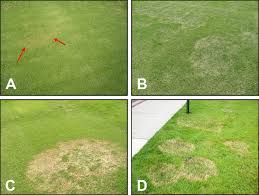
Zoysia patch, caused by Rhizoctonia solani, is the most common disease of zoysiagrass in our region. Symptoms are most common in spring and fall as zoysiagrass enters or breaks winter dormancy. The patches range from just a few feet across to 20 feet or more.  Circular areas of thin, tan zoysiagrass initially develop in late September to early October during cool, rainy weather and again in April and May. Leaf blades, particularly those near the patch edge, may develop a yellow orange color, causing an orange margin.   The symptoms will fade as temperatures increase in summer, but often reappear in the same areas when conditions become more favorable.


Zoysia Patch

Examples of Zoysia Patch